Water Heats Up Again After All Used Water Heater
There's zippo as glorious every bit a hot shower on a cold sleepy morning, or after a long, stressful day at work.
But have you e'er had your hopes for a steamy, relaxing shower met with utter disappointment as you shivered under lukewarm water?
If this is a common occurrence, it's not just a fluke — there actually may exist something amiss with your home'southward hot water system.
How can yous tell? Why does your hot water take ages to warm up, anyway?
In this article, we'll explore all the possible reasons why your hot water takes a long time to heat upwardly. With solutions to putting an end to tepid showers and chilly faucet water, once and for all.
Let's get started!
Reasons Why Your Hot H2o Takes a Long Time to Heat Up
There are a handful of problems and factors that tin can affect your system's ability to produce hot water.
Depending on your unique state of affairs, you may be experiencing 1 or more than of the following issues:
Diddled Fuse or No Gas
Both gas and electrical water heaters are susceptible to the occasional faulty part. When something goes awry with the main components of these units, it can affect their ability to produce an acceptable supply of water to your unabridged domicile.
Do you have a gas h2o heater? If your gas water heater isn't producing hot water at all, the airplane pilot light may accept gone out, or the unit is out of gas.
For an electric h2o heater, a tripped circuit breaker or blown fuse may be to blame. There could also be a chock-full flame sensor that needs cleaning, or the electronic ignition may only produce a faint light (or none at all) even when it's receiving electricity. These issues can also ascend with tankless propane h2o heaters and electric tankless water heaters.
Old H2o Heater
Is your water heater more than a decade erstwhile? Your water heater may non be producing an acceptable supply of hot h2o because it is approaching the cease of its lifetime.
If your water heater is more than eight years old or has meaning wear-and-tear, this could also be why your hot water takes a long time to heat up ‒ or non at all.
Faulty Heating Element
Does your h2o run hot only for a curt amount of time? Do your shower or water fixtures only release lukewarm water?
Electric h2o heaters characteristic a set of upper and lower heating elements, and when these no longer work properly, they can disrupt your supply of hot water.
How exercise y'all know which heating element is faulty?
No hot water & constant supply of lukewarm h2o = a malfunctioning upper heating chemical element.
A small-scale amount of hot water that speedily turns cold = a malfunctioning lower heating element.
Luckily, a faulty heating element is rarely a crusade for concern. Replacing the defective heating element is relatively piece of cake to do and usually doesn't require replacing the h2o heating unit entirely.
Thermostat
Attached to the upper and lower heating elements are thermostats, which control the temperature of the water that the heating elements produce. While the thermostats don't malfunction as frequently as their bordering heating elements, they do crave testing every time your system stops producing hot water.
No hot water = a faulty upper thermostat.
A pocket-size amount of h2o that chop-chop goes cold = a faulty lower thermostat.
Past the aforementioned token, water that is besides hot can also indicate a problem with an electrical water heater's thermostat.
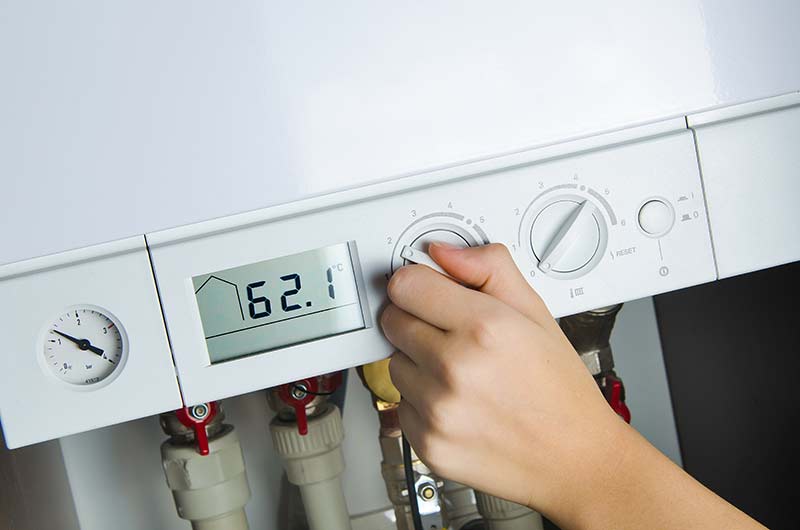
When checking the thermostat, it's a good thought to check whether your meter and main shutoff valves are only partially open up. If the valves are open up, a malfunctioning thermostat is likely the outcome, by and large, and information technology may require replacing.
Distance
The greater the distance between your hot water tank and your shower or faucet, the longer information technology will accept for the hot water to arrive.
So if your shower or kitchen sink are at one end of the house and your water heater is on the other, this could exist partially why your hot water takes ages to warm up.
Pocket-size H2o Heater
Has your family grown since you lot had your electric current water heater installed? Your water heater may exist too small to accommodate your household's demand for hot water.
You lot may desire to consider upgrading to a larger unit or a tankless water heater. We'll explore how to select the correct tank capacity later on in this article.
Depression Water Pressure
A loss in water pressure level can disrupt your water heater's performance ‒ and there'south no shortage of reasons for depression water pressure. In fact, lower water force per unit area can be due to whatsoever of the following:
- A partially airtight meter valve
- A partially closed main shutoff valve
- Sometime pipes
- Faulty pressure regulator
Your plumbing fixtures and faucets may have low volume restrictors. These deejay-shaped barriers can likewise affect your h2o pressure and ho-hum down the catamenia of hot water through your tap fixtures.
Sediment Buildup
Was your water heater installed within the last couple of years but doesn't seem to exist heating water every bit quickly as when yous first had information technology installed? There may be a build-upwards of sediment at the bottom of your hot water tank that is long overdue for a cleaning.
Over fourth dimension, dissolved minerals will settle and collect at the bottom of the tank. In virtually tanks, sediment will build up near the gas burner or electric heater. The sediment can cake the transfer of estrus.
How Long Should Information technology Have for Water to Rut Upward?
Traditionally, electrical heaters accept longer to heat water than gas units. On average, most h2o heaters take an hour to recover, merely many factors can shorten or extend this corporeality of time.
Recovery times vary from unit of measurement to unit. Recovery time refers to the amount of time it takes for a unit to deliver and restore its supply of hot water after it has run out.
Every hot water tank has what'southward known as a first-hour rating (FHR). The FHR measures how much hot h2o a unit can produce in an hour when it is on. Units with high FHR heat a college supply of water per hour.
[Dominion of thumb: The higher the FHR, the more than hot water it can supply in a shorter amount of time. Merely keep in mind that a larger tank volition take longer to recover and may have a lower FHR value.]
Colder atmospheric condition can also bear upon your water heater's performance. Common cold secret air can absurd down the water and brand information technology harder for your h2o heater to heat it effectively. This is especially common in regions that experience heavy snowfall and subzero temperatures during the wintertime.
What Is the Lifetime for a Tank or Tankless Water Heater?
If yous're in the market place for a new h2o heater, whether tankless or with a traditional tank, you may be wondering: How long does a water heater unremarkably last? How can I invest in the correct unit and extend its longevity?
The average lifetime of a gas or electric h2o tank can range anywhere from viii to 15 years. Electric tanks tend to last longer than gas units. Tankless units can concluding up to 20 years! You can learn more nigh the varying lifespans of tanked vs tankless water heaters in this article.
How Can Y'all Get Hot Water Faster?
Did you lot know that your h2o heating system makes up 18% of your home'due south total energy usage?
If you're constantly having to wait for your shower or kitchen faucet to produce hot water, you could exist wasting free energy and increasing your monthly bills. Your shower may fifty-fifty experience constant temperature fluctuations.
By optimizing your home's water heater organisation, you can minimize wasted free energy, ameliorate your habitation'south hot water supply, all while cutting down on your monthly energy bills.
So, what are some means y'all can get hot water faster and improve your energy-efficiency? Let'south accept a look:
Install a New Unit
Selecting the right tank capacity is essential. Hot water tanks accommodate a range of gallon sizes, and your tank specifically should the number of people in your household.
Generally speaking, a household of one to ii people requires a tank capacity of anywhere from 20 to 40 gallons. A household with more than four people will begin to crave a tank capacity of more than 50 gallons, and this figure can increase depending on much hot h2o each individual relies on.
Here's a breakdown of how to summate the corporeality of hot water required with a 36-gallon unit:
If you're having problem deciding betwixt gas vs electric water heaters, we explore the benefits, performance, and durability of both in this article!
Install a Tankless Hot H2o System
Tankless systems don't shop hot water like traditional tanks. Rather, a tankless system, whether powered past electricity or gas, utilizes a heating element, turning water hot and delivering it instantaneously.
A gas or electric tankless system is not necessarily ameliorate than the other. If energy-efficiency is the main concern of yours, y'all may find yourself leaning more towards an electric tankless unit. Still, that doesn't hateful you can't have free energy efficiency with a gas tankless unit!
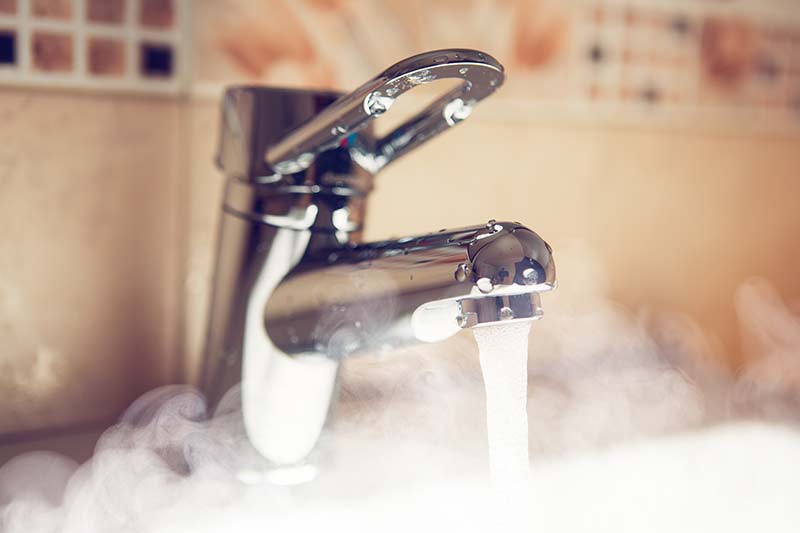
Because tankless systems deliver hot h2o simply when yous plough your shower on or use your water fixtures, they both use up less energy and oestrus, which can lead to lower energy and heating bills every month.
Install a Hot Water Recirculation System
Attaching a recirculation system to your water heater can also quicken the delivery time of hot h2o AND meliorate your energy efficiency.
Activated by a timer or thermostat, a recirculation system pumps water more than quickly from the heater to the fixture and recirculates used water back to the heater. This procedure reduces the amount of water wasted while y'all look for your shower or h2o fixture to deliver hot h2o.
Is Information technology Ameliorate to Exit Hot Water on All the Fourth dimension?
Contrary to pop belief, it is non improve to get out the hot water on all the time. Not only is it recommended to turn your hot water supply on and off when needed, only it is also recommended that you keep your h2o heater's thermostat down to avert scalding hot water.
Why is this?
By leaving the hot water on all the time, you may exist burning upwardly energy and increasing your energy bills.
Most appliances are capable of heating cold water, reducing the need to have a supply of hot water ready at a moment's find. If you plan to take a long hot shower or bathroom, turn the water heater on an hr beforehand.
Insulate Your Hot H2o Heater & Water Pipes
A hot h2o tank with proper insulation tin can go on water hot throughout the solar day and reduce the demand to proceed your unit of measurement on all the fourth dimension.
Homeowners can also insulate their home's h2o pipes to maintain the temperature of hot water as it travels from a heating unit of measurement to the plumbing fixtures. Insulated pipes can fifty-fifty increase the water'south temperature by ii°F-iv°F, allowing homeowners to keep their thermostats at lower temperatures.
Should You Turn Your Water Heater'due south Thermostat Upwardly in the Winter?
Considering underground air is colder in the wintertime, it seemingly makes sense to keep the thermostat upward on your water heater. However, doing so tin waste more energy and increment the run a risk of producing scalding, injury-inducing hot water.
In the winter, you tin can adjust your water heater's thermostat by 5°F to ten°F and run into if it provides an ample and desired supply of hot h2o.
By insulating your water heater, your home's h2o pipes, and simply turning your hot water on when needed, you can maintain slightly higher temperatures in the wintertime without racking upward your energy bills.
Agreement How to Maintain Hot Water in Your Domicile
When y'all desire to take a hot shower or wash the dishes with warm h2o, you shouldn't have to expect or suffer through lukewarm to icy cold water.
There are all types of reasons why our hot h2o takes ages to warm upwardly ‒ merely there are a variety of solutions to improving your h2o heater's operation, maintaining your home's supply of hot water, and enhancing your energy efficiency in the procedure.
If you lot would like to acquire more about water heaters, how to extend the lifetime of your investment, and prefer more energy-efficient practices, stay tuned to our web log!
Source: https://applianceanalysts.com/hot-water-takes-ages-to-warm-up/
0 Response to "Water Heats Up Again After All Used Water Heater"
Post a Comment