People Feared the Japan Bomb Dropping So They Wouldnt Do It Again
When photographer Haruka Sakaguchi beginning tried to connect with survivors of the diminutive bombings of Hiroshima and Nagasaki, her cold calls and emails went unanswered. Then, in 2017, the Brooklyn-based artist decided to visit Nihon herself in hopes of meeting someone who knew a hibakusha—the Japanese word for those affected by the August 1945 attacks.
"I sabbatum at the Nagasaki Peace Park for hours trying to differentiate between tourists and locals who were visiting to pray for a loved i—they often wore juzu, or prayer beads," says Sakaguchi, who immigrated to the U.S. from Japan as an infant in the 1990s. After five hours of people watching, she struck upwardly a conversation with the daughter of a survivor, who agreed to introduce her to eight hibakusha.
Elizabeth Chappell, an oral historian at the Open University in the United Kingdom, encountered similar difficulties after setting out to itemize atomic bomb survivors' testimony. "When y'all have a silenced group like that, they have a very internal civilisation," she explains. "They're very protective of their stories. I was told I wouldn't get interviews."
Survivors' reluctance to discuss their experiences stems in big office from the stigma surrounding Japan'south hibakusha community. Due to a express understanding of radiation poisoning's long-term effects, many Japanese avoided (or outright abused) those affected out of fear that their ailments were contagious. This misconception, coupled with a widespread unwillingness to revisit the bombings and Nippon'south subsequent give up, led most hibakusha to keep their trauma to themselves. But in the past decade or then, documentary efforts similar Sakaguchi's 1945 Project and Chappell's The Concluding Survivors of Hiroshima have get increasingly common—a testament to both survivors' willingness to defy the long-standing culture of silence and the pressing need to preserve these stories equally hibakusha's numbers dwindle.
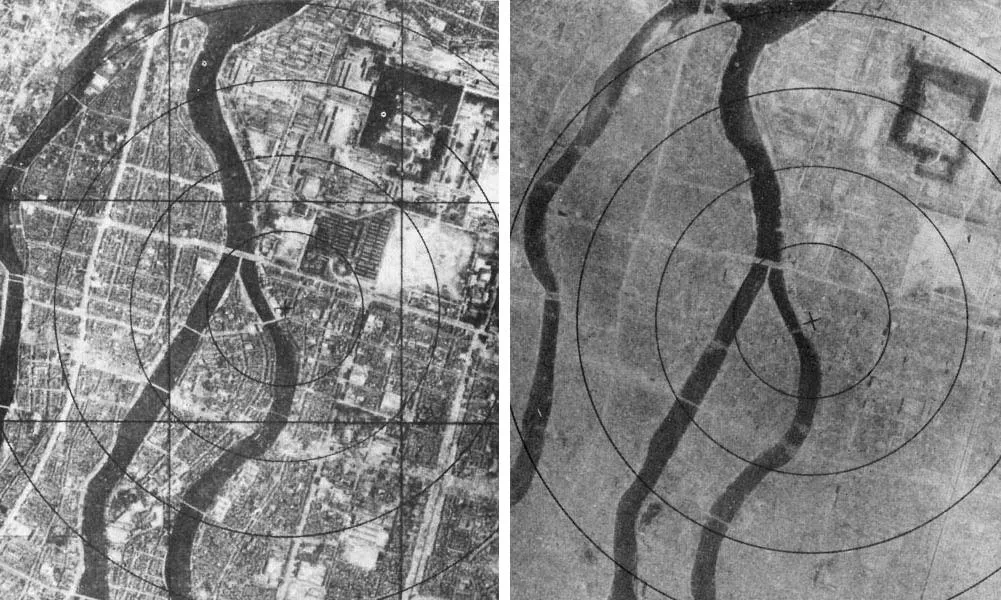
When planning for the war in the Pacific's adjacent phase, the U.South. invasion of mainland Japan, the Truman assistants estimated that American casualties would be betwixt 1.7 and 4 million, while Japanese casualties could number up to 10 million. Per the National WWII Museum, U.Southward. intelligence officers warned that "there are no civilians in Japan," as the regal government had strategically made newly mobilized combatants' attire indistinguishable from civilians. They besides predicted that Japanese soldiers and civilians alike would cull to fight to the death rather than surrender.
Throughout World War II, the Japanese code of bushido, or "way of the warrior," guided much of Emperor Hirohito's strategy. With its deportment in Prc, the Philippines, the surprise attack on Pearl Harbor and elsewhere in Asia, the Imperial Japanese army waged a vicious, indiscriminate campaign against enemy combatants, civilians and prisoners of war. Prizing sacrifice, patriotism and loyalty above all else, the bushido mindset led Japanese soldiers to view their lives equally expendable in service of the emperor and consider suicide more honorable than yielding to the enemy. Later in the war, as American troops advanced on the Japanese mainland, civilians indoctrinated to believe that U.S. soldiers would torture and impale those who surrendered also started engaging in mass suicides. The Battle of Okinawa was a particularly bloody case of this practice, with Japanese soldiers fifty-fifty distributing manus grenades to civilians caught in the crossfire.
The accurateness of the U.S. government'south projections, and the question of whether Emperor Hirohito would accept surrendered without the use of atomic weapons, is the subject of great historical argue. But the facts remain: When the bombing of Hiroshima failed to produce Nippon's immediate surrender, the U.Southward. moved frontwards with plans to drop a 2nd atomic bomb on Nagasaki. That same calendar week, the Soviet Union officially declared war on Japan later years of adhering to a 1941 neutrality pact.
In total, the August six and 9 bombings of Hiroshima and Nagasaki, respectively, killed more than 200,000 people. Half-dozen days after the 2nd attack, Hirohito announced Japan'due south unconditional surrender. The American occupation of Japan, which set up out to demilitarize the country and transform information technology into a democracy, began before long after.
/https://tf-cmsv2-smithsonianmag-media.s3.amazonaws.com/filer/cb/07/cb078810-daa2-4478-9690-127034169ff7/gettyimages-92424064.jpg)
An estimated 650,000 people survived the diminutive blasts, just to find their mail service-war lives marred by health bug and marginalization. Hibakusha received little official assist from the temporary occupying government, every bit American scientists' understanding of radiations's effects was only "marginally meliorate" than that of the Japanese, according to the Atomic Heritage Foundation. In September 1945, the New York Times reported that the number of Japanese people who'd died of radiation "was very small."
Survivors faced numerous forms of discrimination. Survivor Shosho Kawamoto, for instance, proposed to his girlfriend more than a decade after the bombing, but her father forbade the marriage out of fearfulness that their children would conduct the burden of his radiation exposure. Heartbroken, Kawamoto vowed to remain unmarried for the rest of his life.
"Widespread fears that hibakusha are physically or psychologically impaired and that their children might inherit genetic defects stigmatize first- and 2nd-generation hibakusha to this day, particularly female survivors," Sakaguchi says. (Scientists who monitored virtually all pregnancies in Hiroshima and Nagasaki betwixt 1948 and 1954 found no "statistically significant" increment in nativity defects.)
Sakaguchi as well cites accounts of workplace discrimination: Women with visible scars were told to stay abode and avoid "forepart-facing work," while those issued pink booklets identifying them as hibakusha—and indicating their eligibility for healthcare subsidies—were often refused piece of work due to fears of future health complications. Many hibakusha interviewed for the 1945 Project avoided obtaining this paperwork until their children were "gainfully employed [and] married or they themselves became very sick" in order to protect their loved ones from existence ostracized.
/https://tf-cmsv2-smithsonianmag-media.s3.amazonaws.com/filer/71/20/7120c1c3-ff25-47d6-bb4b-bd47af3dae3b/gettyimages-1035636670.jpg)
Peradventure the most jarring aspect of hibakusha'south experiences was the lack of recognition afforded to survivors. As Chappell explains, far from reversing the empire's decades-long policy of strict censorship, U.South. officials in charge of the postwar occupation continued to wield control of the printing, fifty-fifty limiting use of the Japanese give-and-take for atomic bomb: genbaku. After the Americans left in 1952, Japan'south government farther discounted hibakusha, perpetuating what the historian deems "global collective amnesia." Even the 1957 passage of legislation providing benefits for hibakusha failed to spark meaningful discussion—and understanding—of survivors' plight.
Writing in 2018, Chappell added, "[T]he hibakusha were the unwelcome reminder of an unknown, unclassifiable event, something and so unimaginable society tried to ignore it."
More recently, aging hibakusha have grown more vocal about their wartime experiences. They share their stories in hopes of helping the adjacent "generations imagine a different kind of hereafter," according to Chappell, and to plead for nuclear disarmament, says Sakaguchi. Many organizations dedicated to preserving survivors' testimony—the Hiroshima Peace Memorial Museum, the Nagasaki Atomic Bomb Museum and the Hiroshima Peace Civilization Foundation, among others—were actually founded by hibakusha: "They had to be the starting time researchers, [and] they had to be their own researchers," Chappell notes.
Today, hibakusha still face up widespread discrimination. Several individuals who agreed to participate in Sakaguchi's 1945 Projection later withdrew, citing fears that friends and colleagues would run into their portraits. Yet, despite fear of retaliation, survivors continue to speak out. Beneath, detect nine such immediate accounts of the bombings of Hiroshima and Nagasaki, collected here to mark the 75th ceremony of the attacks.
This article contains graphic depictions of the atomic bombings' aftermath. The survivor quotes chosen from interviews with Sakaguchi were spoken in Japanese and translated by the photographer.
Taeko Teramae
/https://tf-cmsv2-smithsonianmag-media.s3.amazonaws.com/filer/a6/1c/a61ce6ab-f43c-4f7d-b470-a5186b545164/harukasakaguchi_1945_042.jpg)
Hiroshima survivor Taeko Teramae didn't realize the full extent of her injuries until her younger brothers started making fun of her appearance. Confused, the fifteen-twelvemonth-old asked her parents for a mirror—a asking they denied, leading her to surreptitiously track ane down on a 24-hour interval they'd left the firm.
"I was then surprised I found my left middle looked just similar a pomegranate, and I also constitute cuts on my right eye and on my nose and on my lower jaw," she recalled. "Information technology was horrible. I was very shocked to observe myself looking like a monster."
On the mean solar day of the bombing, Teramae was i of thousands of students mobilized to aid make full Hiroshima'southward wartime labor shortages. Assigned to the city's Telephone Bureau, she was on the edifice'south 2nd floor when she heard a "tremendous noise." The walls collapsed, momentarily blanketing the workers in darkness. "I began to choke on the consequent fume— poisonous gas, it seemed like—and vomited uncontrollably," wrote Teramae in a 1985 article for Heiwa Bunka magazine.
Amid the din of cries for help, a single voice called out: "We must endure this, similar the proud scholars that we are!" It was Teramae's homeroom teacher, Chiyoko Wakita, who was herself not much older than her students. Comforted by Wakita's words, the children gradually quieted down.
Teramae managed to escape by jumping out of a second-story window and climbing down a telephone pole. But when she tried to cross the Kyobashi River to safety, she establish its just span in flames and the city she'd left behind "engulfed in a sea of fire." Again, Wakita came to her charge's rescue, accompanying her on the swim across the river and offering encouragement throughout the arduous journey. After dropping Teramae off at an evacuation heart, the young teacher returned to Hiroshima to help her other students. She died of her injuries on August 30.
"[Wakita] saved my life, yet I was not able to tell her a simple 'thank you,'" Teramae later said. "I deeply regret this, to this solar day."
Sachiko Matsuo
/https://tf-cmsv2-smithsonianmag-media.s3.amazonaws.com/filer/83/8b/838b784d-99fa-480b-9167-47d2981260a2/harukasakaguchi_1945_041.jpg)
Erstwhile earlier the bombing of Nagasaki, 11-year-old Sachiko Matsuo's begetter happened upon a leaflet dropped by American pilots to warn the city'southward residents of an imminent attack. Taking the message seriously, he constructed a makeshift motel high up on a mountain overlooking Nagasaki and, in the days leading up to the scheduled bombing, implored his extended family to take shelter there from morning until evening. Just when August 8—the supposed day of the set on—passed without incident, Matsuo'south mother and aunt told him they wanted to stay home.
Reflecting on the argument that followed in an interview with Sakaguchi, Matsuo said her father demanded that the pair return to the barracks, pointing out that the Us' time zone was one day behind Japan's. "When they opposed, he got very upset and stormed out to go to work," she added. Meanwhile, his remaining family members "changed our minds and decided to hide out in the banter for 1 more than solar day." The bomb struck just hours subsequently. All those hidden in the motel survived the initial impact, albeit with a number of astringent burns and lacerations.
"After a while, we became worried about our house, so I walked to a place from where I would exist able to see the house, only in that location was something like a big deject roofing the whole city, and the cloud was growing and climbing up toward us," Matsuo explained in 2017. "I could see nothing below. My grandmother started to cry, 'Everybody is dead. This is the end of the world.'"
Matsuo's begetter, who'd been stationed outside of an artillery manufacturing plant with his civil defence force unit when the flop struck, returned to the motel that afternoon. He'd sustained several injuries, including wounds to the head, hands and legs, and required a cane to walk. His eldest son, who'd also been out with a civil defense force unit, died in the blast. The family subsequently spotted his corpse resting on a rooftop, but by the fourth dimension they returned to retrieve information technology, the body was gone.
In the weeks after the bombing, Matsuo's male parent began suffering from the effects of radiation. "He soon came down with diarrhea and a high fever," she told Sakaguchi. "His pilus began to fall out and dark spots formed on his skin. My begetter passed away—suffering greatly—on August 28."
Norimitsu Tosu
Every morning, Norimitsu Tosu's mother took him and his twin brother on a walk around their Hiroshima neighborhood. Baronial half dozen was no different: The trio had only returned from their daily walk, and the three-year-olds were in the bathroom washing their easily. Then, the walls collapsed, trapping the brothers under a pile of debris. Their mother, who'd briefly lost consciousness, awoke to the audio of her sons' cries. Bleeding "all over," Tosu told the National Cosmic Reporter 's David Due east. DeCosse in 2016, she pulled them from the rubble and brought them to a relative's business firm.
V of Tosu's vii immediate family members survived the bombing. His father, temporarily jailed over an accusation of bribery, was shielded past the prison's strong walls, only two siblings—an older brother named Yoshihiro and a sis named Hiroko—died. The family unit was only able to learn of Yoshihiro's fate: According to Tosu, "We didn't know what happened to [Hiroko], and we never located her body. Nothing. We didn't even know where exactly she was when the bomb exploded."
Given his age at the time of the set on, Tosu doesn't remember much of the actual aftermath. Merely as he explained to grandson Justin Hsieh in 2019, ane memory stands out:
When we were evacuating, in that location were dead horses, dogs, animals and people everywhere. And the smells I remember. There was this terrible smell. It smelled like canned salmon. So for a long fourth dimension after that, I couldn't eat canned salmon because the smell reminded me of that. It was sickening. And so more than annihilation I saw or heard, it was the olfactory property that I recollect the near.
Yoshiro Yamawaki
/https://tf-cmsv2-smithsonianmag-media.s3.amazonaws.com/filer/76/01/76012a32-1b02-487e-9c61-38f268e3c31a/harukasakaguchi_1945_005.jpg)
The day after the U.Due south. dropped an atomic bomb on Nagasaki, 11-year-old Yoshiro Yamawaki went out in search of his male parent, who had failed to return from a shift at the local power station. On the way to the factory, Yamawaki and two of his brothers saw unspeakable horrors, including corpses whose "peel would come peeling off just like that of an over-ripe peach, exposing the white fat underneath"; a young woman whose intestines dragged behind her in what the trio at offset idea was a long white material belt; and a half dozen- or 7-yr-old boy whose parasitic roundworms had come "shooting out" of his oral fissure post-mortem.
The boys soon arrived at the power station, which was situated virtually the bomb'due south hypocenter and had been reduced to petty more than a pile of scorched metallic. Spotting three men with shovels, they called out, "Our name is Yamawaki. Where is our father?" In response, 1 of the men pointed toward a demolished building across the street and just said, "Your begetter is over there."
Joy quickly turned to anguish every bit the brothers spotted their father'south corpse, "bloated and scorched just like all the others." After consulting with the older men, they realized that they'd need to either cremate his remains to bring home to their female parent or bury his trunk onsite. Unsure what else to do, they gathered smoldering pieces of wood and congenital a makeshift funeral pyre.
The men advised the brothers to come back for their begetter'south ashes the post-obit twenty-four hours. Also overcome with emotion to remain, they agreed. But upon returning to the mill the post-obit morning, they plant their male parent's half-cremated body abandoned and coated in ash.
"My brother looked at our male parent'south trunk for a while longer, and then said, 'We can't practise anything more. We'll just take his skull abode and that will be the end,'" Yamawaki recalled at historic period 75.
When the young boy went to call back the skull with a pair of tongs brought from home, however, "it crumbled apart like a plaster model and the half-burned brains came flowing out."
"Letting out a scream, my brother threw down the tongs, and darted away," said Yamawaki. "The two of u.s.a. ran after him. [These] were the circumstances under which we forsook our father'southward body."
Sakaguchi, who photographed Yamawaki for the 1945 Projection, offers another perspective on the incident, maxim, "Bated from the traumatic feel of having to cremate your own begetter, I was nonplussed by Mr. Yamawaki and his brothers' persistence—at a young age, no less—to transport their father off with quietude and dignity under such devastating circumstances."
Kikue Shiota
August half-dozen was "an unimaginably beautiful day" punctuated by a "blinding light that flashed as if a thousand magnesium bulbs had been turned on all at once," Hiroshima survivor Kikue Shiota after recalled. The blast trapped 21-year-old Shiota and her 16-yr-old sister beneath the remains of their razed house, more than a mile from the bomb'due south hypocenter.
Later on Shiota's begetter rescued his daughters from the rubble, they set up out in search of their remaining family members. Burned bodies were scattered everywhere, making information technology impossible to walk without stepping on someone. The sisters saw a newborn baby all the same fastened to its dead mother's umbilical cord lying on the side of the road.
As the pair walked the streets of Hiroshima, their x-year-old blood brother conducted a similar search. When Shiota finally spotted him standing amongst a crowd of people, she was horrified: "All the skin on his face was peeling off and dangling," she said. "He was limping feebly, all the skin from his legs burned and dragging backside him like a heap of rags."
The young boy survived his injuries. His 14-year-old sister, Mitsue, did not. Though the family never recovered her body, they were forced to face the worst afterward finding a fleck of Mitsue's schoolhouse uniform burned into the cobblestone.
"I idea my heart would surely stop because the very cloth I institute was my sister'due south, Mitsue, my piffling sister," Shiota remembered. "'Mi-chan!' I called out to her. 'Information technology must take been terribly hot. The pain must accept been unbearable. You must have screamed for help.' … My tears falling, I searched for my sister in vain."
One month after the bombing, the family lost another loved ane: Shiota'south mother, who had appeared to be in proficient health upward until the 24-hour interval earlier her passing, died of astute leukemia caused by the smash's radioactive rays. She was cremated in a pit dug by a neighbor equally her grief-stricken daughter looked on.
Akiko Takakura
/https://tf-cmsv2-smithsonianmag-media.s3.amazonaws.com/filer/cf/37/cf37cb2f-fde2-4bcc-8446-412542c1fa70/ge14-06.jpg)
Decades afterwards the bombing of Hiroshima, the prototype of a homo whose charred fingertips had been engulfed in blue flames remained imprinted in Akiko Takakura'southward retention. "With those fingers, the man had probably picked up his children and turned the pages of books," the then-88-year-quondam told the Chugoku Shimbun in 2014. The vision and then haunted Takakura that she immortalized it in a 1974 drawing and recounted it to the many schoolchildren she spoke to as a survivor of the August 6 assault. "More than than 50 years later, / I remember that bluish flame, / and my eye nigh bursts / with sorrow," she wrote in a poem titled "To Children Who Don't Know the Atomic Bomb."
Takakura was 19 years one-time when the bomb roughshod, detonating in a higher place a quiet street close to her workplace, the Hiroshima branch of the Sumitomo Bank. She lost consciousness after seeing a "white magnesium flash" but later on awoke to the sound of a friend, Kimiko Usami, crying out for her mother, according to testimony preserved by the Hiroshima Peace Culture Foundation. The pair managed to escape the building, which had partially shielded those inside with its reinforced concrete walls, and venture into the street. In that location, they encountered a "whirlpool of fire" that burned everything information technology touched.
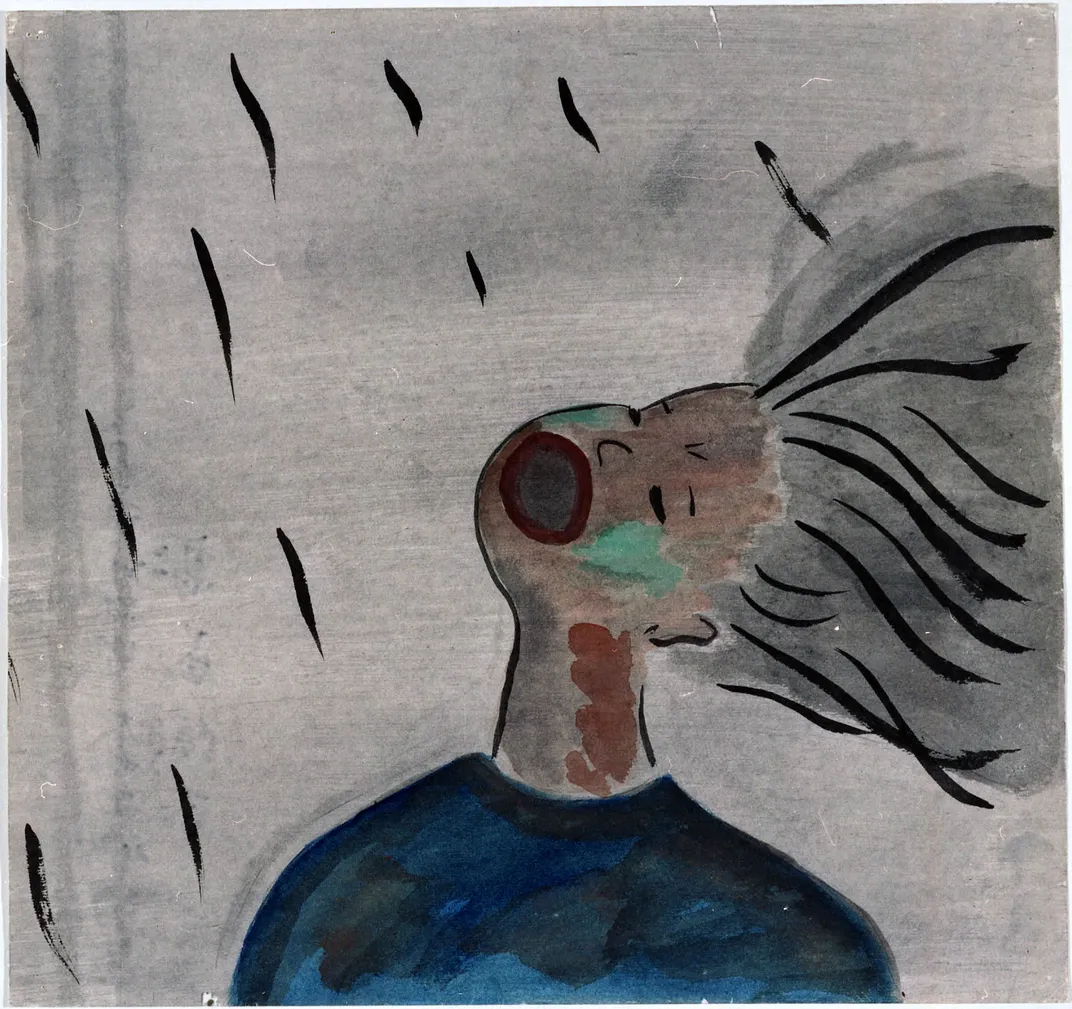
"It was but like a living hell," Takakura recalled. "After a while, it began to pelting. The burn down and the fume made us so thirsty and there was nothing to drink. … People opened their mouths and turned their faces toward the sky [to] try to drinkable the rain, but it wasn't easy to take hold of the rain drops in our mouths. Information technology was a black rain with big drops." (Kikue Shiota described the rain equally "inky black and oily similar coal tar.")
The burn down eventually died down, enabling Takakura and Usami to navigate through streets littered with the "carmine-brown corpses of those who were killed instantly." Upon reaching a nearby drill ground, the young women settled in for the nighttime with only a sail of corrugated tin for warmth. On August 10, Takakura's mother took her girl, who had sustained more than 100 lacerations all over her body, home to brainstorm the lengthy recovery process. Usami succumbed to her injuries less than a month later on.
Hiroyasu Tagawa
In the jump of 1945, government-mandated evacuations led 12-year-old Hiroyasu Tagawa and his sister to move in with their aunt, who lived a short altitude abroad from Nagasaki, while his parents relocated to a neighborhood close to their workplace in the city center.
On the forenoon of Baronial 9, Tagawa heard what he thought might be a B-29 bomber flying overhead. Curious, he rushed outside to take a look. "Suddenly everything turned orange," Tagawa told Forbes' Jim Disharmonism in 2018. "I quickly covered my optics and ears and laid downwards on the ground. This was the position we expert daily at school for times like this. Soon dust and debris and pieces of drinking glass were flight everywhere. After that, silence."
All those living at the aunt's house survived the blast with minor injuries. But later on three days passed with no news of his parents, Tagawa decided to go to the city center and search for them. There, he constitute piles of corpses and people similarly looking for missing family unit members. "Using long bamboo sticks, they were turning over one corpse after the other as they floated down the river," he recalled. "There was an eerie silence and an overwhelming stench."
/https://tf-cmsv2-smithsonianmag-media.s3.amazonaws.com/filer/ab/56/ab56d41e-0826-48db-98a4-def5c1e1d1b1/gettyimages-807123.jpg)
Tagawa'southward mother establish him offset, calling out his name as he walked down the street. She and her husband had been staying in a shelter, besides badly injured to brand the trek dorsum to their children. Mr. Tagawa was in particularly poor shape: A factory worker, he'd been handling unsafe chemicals when the flop struck. Its impact sent the toxic materials flying, severely called-for his feet.
Determined to aid his bilious father, Tagawa recruited several neighbors to help behave him to a temporary infirmary, where doctors were forced to amputate with a carpenter's saw. His begetter died 3 days later, leaving his grieving son uncertain of whether he'd washed the right thing. "I wondered if I had done wrong by taking him over there," Tagawa told the Japan Times' Noriyuki Suzuki in 2018. "Had I non brought him to accept the surgery, perhaps he would've lived for a longer fourth dimension. Those regrets felt like thorns in my center."
More tragedy was nevertheless to come up: Shortly afterward Tagawa returned to his aunt's boondocks to deliver news of his father's death, he received discussion that his mother—suffering from radiations poisoning—was now in critical condition. Bicycling back to her bedside, he arrived just in time to say adieu:
My aunt said, "Your female parent almost died last nighttime, but she wanted to meet you 1 last time. So she gave it her best to alive i more day." My mother looked at me and whispered, "Hiro-chan, my honey child, abound up fast, okay?" And with these words, she drew her last breath.
/https://tf-cmsv2-smithsonianmag-media.s3.amazonaws.com/filer/50/24/50241346-e134-4e4a-b288-abb9bff64504/gettyimages-520831233.jpg)
Shoso Kawamoto
/https://tf-cmsv2-smithsonianmag-media.s3.amazonaws.com/filer/8c/6a/8c6a0594-b99a-4abe-aac7-92a2f8c999dd/gettyimages-2637030.jpg)
Eleven-year-onetime Shoso Kawamoto was one of some two,000 children evacuated from Hiroshima's city center ahead of the August 6 bombing. As he told the Chugoku Shimbun in 2013, he'd been working in a field north of the city alongside other young evacuees when he noticed a white cloud rise in the sky above Hiroshima. That night, caretakers told the grouping of 6- to 11-year-olds that the city center—where many of the children's families lived—had been obliterated.
Iii days later, Kawamoto'southward 16-yr-old sister, Tokie, arrived to pick him upwardly. She arrived with sobering news: Their mother and younger siblings had "died at home, embracing one another," and their father and an older sis were missing. Kawamoto never learned exactly what happened to them. (Co-ordinate to Elizabeth Chappell, who has interviewed Kawamoto extensively, his "samurai mother and ... farmer father" came from different backgrounds and raised their children in a strict neo-Confucian household.)
After reuniting, the siblings moved into a ruined train station, where they witnessed the plight of other orphaned children. "[West]e did not take enough food to survive," Kawamoto later explained to author Charles Pellegrino. "Nosotros were in a constant tug-of-war over food—sometimes but one dumpling. In the end, the strong survived and the weak died ane after another." Most orphans died within months, wrote Chappell for the Conversation in 2019: Though local women tried to feed them, there simply weren't plenty rations to go around.
Tokie died of an undiagnosed illness, likely leukemia, in February 1946. Following her passing, a soy sauce factory owner took Kawamoto in, feeding and sheltering him in substitution for 12 years of labor. At the finish of this catamenia, the human being rewarded his surrogate son with a house.
Tsutomu Yamaguchi
/https://tf-cmsv2-smithsonianmag-media.s3.amazonaws.com/filer/4e/a7/4ea72902-6cf6-4838-81ae-b64c7b191fcd/gettyimages-85578931.jpg)
To date, the Japanese government has recognized just one survivor of both the Hiroshima and Nagasaki bombings: naval engineer Tsutomu Yamaguchi, who died in 2010 at age 93. A longtime Nagasaki resident, he'd spent the summer of 1945 on temporary assignment in Hiroshima. August 6 was ready to exist his last day of work before returning home to his wife and baby son.
That morning, the 29-year-old was walking to the shipyard when a "great flash in the sky" rendered him unconscious. Upon waking up, Yamaguchi told the Times' Richard Lloyd Parry, he saw "a huge mushroom-shaped pillar of burn rising up high into the sky. It was like a tornado, although it didn't motility, but it rose and spread out horizontally at the top. There was prismatic light, which was changing in a complicated rhythm, like the patterns of a kaleidoscope."
/https://tf-cmsv2-smithsonianmag-media.s3.amazonaws.com/filer/0c/52/0c52361d-782e-43b6-adb2-331998ea7d0f/gettyimages-568884791.jpg)
The blast ruptured Yamaguchi's eardrums and burned his face and forearms. But after reuniting with ii co-workers—Akira Iwanaga and Kuniyoshi Sato—the trio managed to retrieve their belongings from a dormitory and start making their way to the train station. On the way, "We saw a mother with a infant on her back," Yamaguchi recalled. "She looked equally if she had lost her mind. The child on her back was expressionless and I don't know if she even realized."
Sato, who forth with Iwanaga as well survived both bombings, lost track of his friends on the railroad train ride back to Nagasaki. He ended upward sitting beyond from a young man who spent the journeying clasping an awkwardly covered bundle on his lap. Finally, Sato asked what was in the package. The stranger responded, "I married a month ago, but my married woman died yesterday. I want to accept her home to her parents." Beneath the textile, he revealed, rested his love'south severed head.
Upon reaching Nagasaki, Yamaguchi visited a hospital to receive treatment for his burns. Deeming himself fit to work, he reported for duty the next day and was in the center of recounting the bombing when another blinding wink of calorie-free filled the room. "I thought the mushroom cloud had followed me from Hiroshima," he explained to the Independent'due south David McNeill in 2009.
Yamaguchi was relatively unhurt, and when he rushed to check on his wife and son, he constitute them in a similar state. Only over the next several days, he started suffering from the effects of radiation poisoning: As Evan Andrews wrote for History.com in 2015, "His hair fell out, the wounds on his arms turned gangrenous, and he began airsickness endlessly."
With time, Yamaguchi recovered and went on to live a normal life. He was, in fact, so good for you that he avoided speaking out near his experiences for fear of existence "unfair to people who were really sick," as his daughter Toshiko told the Independent. In total, an estimated 165 people survived both bombings. Yamaguchi remains the just 1 to receive official recognition.
Source: https://www.smithsonianmag.com/history/nine-harrowing-eyewitness-accounts-bombings-hiroshima-and-nagasaki-180975480/
0 Response to "People Feared the Japan Bomb Dropping So They Wouldnt Do It Again"
Post a Comment